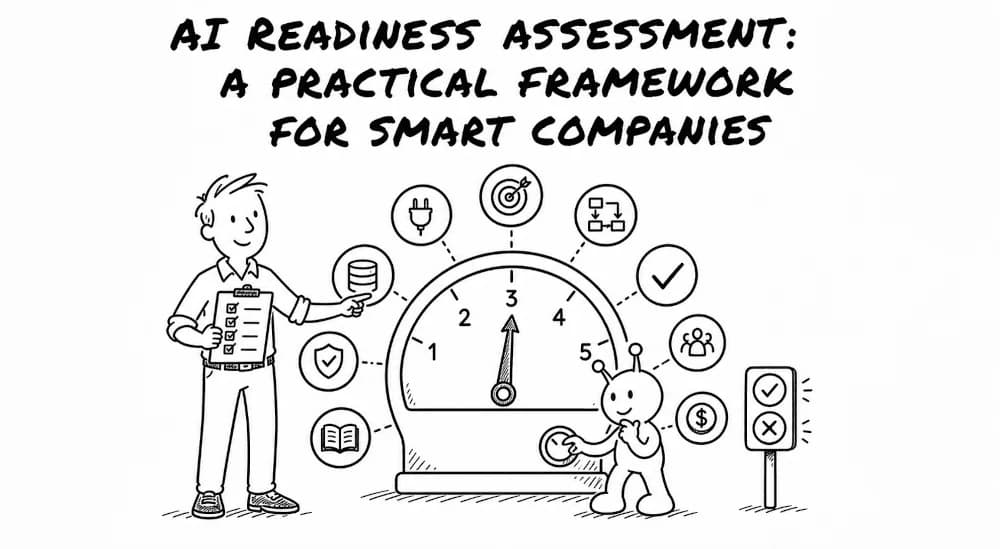
AI Readiness Assessment: A Practical Framework for Smart Businesses
Jumping straight into an AI build without checking your foundation is a fast way to burn cash.
Small and medium-sized businesses (SMBs) don't have money to waste on pie-in-the-sky AI experiments with low chances of working.
That is where an AI readiness assessment comes in.
An AI readiness assessment is a practical audit of your organization's preparedness to identify, implement, run, govern, scale, and sustain AI solutions. It is about checking your current state against what is needed to succeed so you can spot the critical gaps before you start allocating resources building.
You don't need everything to be perfect to get started, but you cannot have blockers that will kill your project's momentum before it starts.
Here is the exact AI readiness framework we use to audit companies, evaluate current capabilities, and decide if a business is ready to scale AI.
The 9 Pillars of Organizational AI Readiness
1. Data Legibility and Accessibility
Data is the lifeblood of any AI system. If your data is trapped in paper files, locked inside desktops, or scattered across disconnected silos, an AI agent cannot do anything with it. Having the best AI model without clean, accessible data won't gain any traction. For true data readiness for AI, your data needs to be digital, structured, up-to-date, and accessible via APIs or Model Context Protocol (MCP) servers.
Signs of Readiness:
- Core operational data is digitized and accessible via APIs, files, databases, or MCP connections.
- Clear data governance rules define who and what can access sensitive records.
- You maintain a known inventory of your data sources and have a plan to feed clean context to AI agents.
Warning Signs:
- Critical company data is stuck on paper, local PDFs, or messy legacy software with no export options.
- Data contains duplicate records, conflicting customer entries, and no standard formats.
- Proprietary data is trapped exclusively in the minds of a few people.
2. Tech Stack and Infrastructure
Your current software ecosystem determines how easily AI can integrate into your day-to-day operations. How AI-friendly are your CRM, ERP, accounting software, and project management tools? If your core systems offer modern webhooks, robust APIs, and flexible developer tooling, you can wire up AI agents quickly. If your business runs on on-premise software built 20 years ago, you will spend months building painful middleware before an agent can even read a record.
Signs of Readiness:
- Core tools (CRM, ticketing, project management) have open APIs and modern integration support.
- Your infrastructure strategy avoids single-vendor lock-in, letting you swap between Anthropic, OpenAI, or open-source models as capabilities shift.
- You have an internal technical lead or external technical partners who understand modern AI harnesses.
Warning Signs:
- Your core systems require manual file exports to share basic information.
- The IT environment is locked down to the point where even sandboxed API testing is impossible.
- You are betting your entire company roadmap on a single proprietary tool wrapper.
3. Business Strategy and Alignment
Never build an AI solution just for the sake of saying you use AI. A real business AI readiness audit looks at whether your leadership team has tied AI initiatives to actual bottom-line business outcomes. Are you trying to reduce customer support turnaround time from 4 hours to 5 minutes? Are you trying to double sales proposal output without adding headcount? If you cannot name the exact business problem you are solving, your project will drift into an expensive wild goose chase.
Signs of Readiness:
- Executive leadership is aligned on the top 2 or 3 priority problems to solve with AI.
- You have mapped your AI roadmap directly to measurable business goals. Check out our deep dive on how to create an AI strategy aligned with business goals or explore our AI strategy and consulting services for more on this.
- Expected business outcomes (cost reduction, capacity expansion, revenue acceleration) are clearly defined.
Warning Signs:
- AI initiatives are launched purely out of FOMO or board pressure with no defined target.
- Leadership expects AI to magically fix broken business models without changing underlying operations.
- Nobody owns the project outcomes after deployment.
4. Standard Operating Procedures (SOPs) and Workflows
Building fancy AI agents on top of broken or undocumented processes won't work. AI cannot optimize a process that your own team does not understand. If your workflows change every time a different employee does the job, an AI model will simply replicate that confusion at lightning speed. You need documented, repeatable workflows before you can build reliable automated documents and workflows.
Signs of Readiness:
- Core business processes have written, step-by-step documentation or video walkthroughs.
- Workflows follow a consistent, repeatable path from trigger to completion.
- There is a clear change management process to update SOPs as AI tools get introduced.
Warning Signs:
- Every employee does the same core task a different way.
- No SOPs exist for the workflows you want to automate.
- Key steps depend entirely on unspoken intuition that nobody has ever recorded.
| Process Category | Best Approach | Example Workflows |
|---|---|---|
| Repetitive + Documented | Automate with AI | High-volume data entry, proposal drafting, ticket categorization, routine reporting. |
| Nuanced + Mission-Critical | Human in the Loop | Final contract signoff, high-stakes sales, crisis support, core IP architecture. |
5. Use Case Evaluation, Verification, and Evals
An AI agent deployed without verification guardrails leaves you rudderless. You must know how you will evaluate outputs before you click "run." Some tasks require 100% precision (financial accounting, medical data), while others have a higher tolerance for variation (drafting creative marketing copy, initial email triage).
Signs of Readiness:
- You have chosen target use cases with high repetition and clear output criteria (e.g. proposal drafts, invoice classification, tier-1 customer inquiries).
- A clear definition exists for what constitutes a "passing" or "failing" AI response.
- Human-in-the-loop review points are built into sensitive and client-facing workflows.
Warning Signs:
- Attempting to automate highly subjective, mission-critical decisions without human verification.
- No plan or framework to grade the accuracy of agent outputs.
- Expecting perfection from generative systems without guardrails or deterministic checks.
6. Team, Culture, and Agency
The best AI systems fail when the team doesn't use them. Successful AI transformation happens when frontline workers feel empowered rather than threatened. Non-technical staff must feel comfortable experimenting, providing feedback, and tweaking workflows. If your employees view AI as a threat to their jobs, they will quietly sabotage adoption or ignore the tools altogether.
Signs of Readiness:
- Employees are curious about new tech and encouraged to experiment without fear of making mistakes.
- Frontline workers have direct channels to give feedback on how AI tools are working.
- Non-technical subject matter experts have the agency to review, edit, and iterate on agent prompts and skills.
Warning Signs:
- Severe internal resistance, fear of job replacement, and widespread tech illiteracy.
- Little to no training or onboarding plan for staff affected by new AI workflows.
- Siloed departments where developers build tools without ever talking to the end users.
7. Security, Privacy, and Governance
Using modern AI development tools and agentic environments delivers high productivity, but you cannot sacrifice company security in the process. You need crystal-clear boundaries on what data can be sent to third-party LLMs, what must stay on local infrastructure, and how customer privacy is maintained.
Signs of Readiness:
- Formal data classification policies separate public, internal, and confidential/proprietary data.
- Clear vendor policies govern zero-data-retention agreements with frontier AI providers.
- Security reviews are standard practice before onboarding any new AI tool or plugin.
Warning Signs:
- Employees paste sensitive customer records, financial statements, or raw source code into consumer AI chatbots.
- No privacy policy addresses AI data usage for client information.
- No audit logs exist to track what data AI agents access across internal databases.
8. Token Economics and Financial Planning
AI is not free. Between API token usage, tool subscriptions, infrastructure hosting, and potential engineering consultants, costs can add up. You need to know whether your business model supports high token usage for complex multi-agent loops or if you need to optimize for leaner resources. More importantly, you need a framework to calculate whether a spent token creates more enterprise value than it consumes.
Signs of Readiness:
- Dedicated budget allocated for AI software, API usage, team training, and consulting.
- Financial models that weigh the cost of API calls against labor hours saved and revenue unlocked.
- Spend limits, rate limits, and alerting configured on all developer API accounts.
Warning Signs:
- No budget set aside for ongoing token usage or tech stack maintenance.
- Little visibility into which teams or automated tasks are driving API spend.
- Treating AI as a one-time software purchase instead of an ongoing operational utility.
9. Brand Voice, Wiki, and Business Logic
Leaving your company's core knowledge trapped in the heads of your senior employees is like running your business on campfire oral tradition. If you do not write down your brand voice, operational heuristics, and business logic, your AI systems wake up with total amnesia every morning. When you build centralized AI knowledge systems and company wikis, agents can draft communications and solve problems in your exact company DNA.
Signs of Readiness:
- Documented brand voice guidelines, tone examples, and sample outputs exist in a centralized wiki.
- Business logic (pricing rules, customer tier policies, edge-case protocols) is written down clearly.
- A single source of truth exists for company context that agents can query in real time.
Warning Signs:
- Every marketing asset or client email sounds like a generic, robotic template.
- Company policies are passed down verbally without any written documentation.
- Conflicting internal documentation gives AI systems contradictory instructions.
The AI Readiness Assessment Framework and Scoring Rubric
To make this audit actionable, evaluate your organization across a 1 to 5 readiness scale. Score your company from 1 (lowest) to 5 (highest) across each of the 9 pillars above.
| Level | Score Range | Stage | What It Looks Like in Practice |
|---|---|---|---|
| Level 1 | 9 – 18 pts | Square One (Analog First) | Manual, paper-heavy, siloed data, no documented SOPs. |
| Level 2 | 19 – 27 pts | AI Curious (Ad-Hoc Experimenter) | Individuals use chat tools, but no strategic direction or data governance. |
| Level 3 | 28 – 34 pts | Foundational Ready (Pilot Ready) | Clean data, solid APIs, documented SOPs, clear pilot goals. |
| Level 4 | 35 – 40 pts | Operationally Solid (Scaler) | Integrated agents, active evals, strong team adoption, tracked ROI. |
| Level 5 | 41 – 45 pts | AI First (Autonomous Optimizer) | Central brain architecture, automated evals, continuous self-improving loops. |
The Go / No-Go Decision Rubric
- Score < 18 (No-Go for Complex Builds): Do not start building custom AI agents yet. Focus your resources on modernizing your tech stack, digitizing your data, and writing SOPs.
- Score 18 - 34 (Go for Targeted Pilots): Pick one high-value, low-risk use case with clean data and a human in the loop. Prove ROI and build team confidence while strengthening your foundation.
- Score 35+ (Go for Multi-Agent Workflows): You are ready to scale custom AI agents and automations, connect internal MCP servers, and deeply integrate AI into your core customer and operational pipelines.
How to Conduct an AI Readiness Audit for Your Business
Running an audit is straightforward when you follow a structured checklist:
| Step | Workflow Phase | Core Objective |
|---|---|---|
| Step 1 | Appoint Lead | Choose an internal champion or bring in an external AI readiness consulting team like Superfoo. |
| Step 2 | Stakeholder Interviews | Talk to frontline workers and department heads to uncover workflow bottlenecks. |
| Step 3 | Systems & Data Audit | Catalog software tools, databases, API access, and data governance policies. |
| Step 4 | Gap Analysis & Scoring | Grade your organization across all 9 pillars and calculate your readiness score. |
| Step 5 | Roadmap & Action Plan | Build a 90-day pilot roadmap (if Go) or a 60-day remediation plan (if No-Go). |
- Appoint an Assessment Lead: Choose an internal champion or bring in an external AI strategy and consulting team like Superfoo to run an objective review.
- Interview Key Stakeholders: Talk to frontline workers, department heads, and IT. Find out where manual work creates bottlenecks and where past tech projects failed.
- Inventory Your Data and Systems: Catalog your software licenses, database structures, API availability, and privacy policies.
- Compile the Gap Report: Grade your organization against the 9 pillars, identify the exact blockers, and calculate your total score.
- Establish the Action Plan: If you get a "Go" score, outline your first 90-day pilot. If you get a "No-Go," build a 60-day remediation roadmap to clean up data, systems, and SOPs first.
Build the Foundation First
AI is going to reshape how small and medium-sized businesses operate, compete, and win over the next 12 to 24 months.
Companies that take the time to run a proper AI readiness audit, fix their data pipelines, and align their teams will build high-margin, AI-first machines. Companies that skip the fundamentals will keep burning money on failed proofs of concept.
Audit your foundation, fix the gaps, and then proceed with confidence. You don't need to be perfect, but you need to know where you stand.