How to Create an AI Strategy Aligned with Business Goals
Your company is probably dabbling with AI. But does it have an AI strategy tied to actual business goals?
The idea is not to just be a company that uses AI, but become a company that is built with AI integrated into its core.
A strategy tells you which problems matter, what you will say no to, how you will measure progress, and what evidence will make you scale or stop an initiative.
Maybe you don't know where to start. Which is fair. There is no standard template to follow. It's early.
Here is a practical way to build that plan for the next 3 to 12 months.
1. Start with business goals, not AI tools
Pull out the goals from your latest annual plan or quarterly review. Add any newer goals that now matter.
For each goal, write down the KPI and the current baseline. If the company wants to reduce customer churn, what was the churn rate over the last 12 months? If it wants more qualified leads, how many does it get today and what does each lead cost?
A working AI demo is not the same as a business result. You need to know what happened before the new system so you can judge what changed after it.
Not every useful project needs to make money right away. A learning project can be worthwhile. So can work that lowers risk or builds a new skill inside the company. But it should still have a clear reason, budget, timeframe, and learning goal.
2. Find opportunities downstream of those goals
Now brainstorm AI projects that could affect each goal.
Look at the workflows behind the KPI. Where does work slow down? Where do people repeat the same step? Where does missing information lead to a bad decision? Where could a better process create more revenue or lower cost?
A useful strategy combines two views:
- Top down: Leadership sets the business outcomes and limits.
- Bottom up: The people closest to the work show where delays, rework, and hidden constraints exist.
This keeps the plan tied to company goals without missing the problems that only frontline teams can see.
Sometimes the hardest part is knowing what is even possible to build with AI. You can't rank projects you haven't imagined yet. This is where a firm like Superfoo can help. We can learn how your company works, show you which projects are good candidates based on its goals, and help you understand what is now possible. Then we can help you build the projects that make the cut.
Take customer churn as an example. Suppose the company's larger aim is to provide the best customer service in its industry. One measurable goal could be to reduce churn by 15%.
A possible AI initiative could analyze past customer behavior, flag accounts that may leave, and suggest an added service, product feature, or offer for the customer-success team to provide.
The baseline is the churn rate from the previous 12 months. The main KPI is whether churn reaches the target for the group included in the pilot. The team should also watch revenue and customer mix so a lower churn rate does not hide a worse business result.
That turns “use AI in customer service” into a project the company can judge.
3. Decide how big a bet you are willing to make
The right level of ambition depends on your resources, AI experience, data, systems, and comfort with risk.
There are three broad choices:
- Wait and learn. Watch how the technology and market develop. This may fit a company with limited resources or no clear use case.
- Start with a focused project. Pick a known workflow, set a narrow target, and use the result to build experience.
- Redesign part of the business. Rethink the workflow from the ground up instead of adding AI to every old step.
But this is also the time to be ambitious. You need to think as “AI-pilled” as possible. Adding AI to an existing workflow may be the right move. But don't assume the old workflow needs to survive. AI may let you radically change it or eliminate it altogether.
A small project is not always safer if it solves a problem that does not matter. A larger redesign can be more aligned with the business if it attacks the real constraint behind a major goal.
Ask two questions for every idea:
- How much are we willing to commit before we see evidence?
- What result would justify the next round of time, money, and effort?
4. Plan for where AI is going
You want to skate to where the puck is going, not write a plan that assumes today's AI costs and capabilities will stay fixed.
Your strategy should account for a few likely shifts: token costs may keep falling, open-weight models may continue to close the gap with frontier models, and AI systems will keep getting more capable.
These are assumptions, not guarantees. Write them down that way. Then ask how each one would change your choices.
- If inference gets cheaper, which high-volume workflows become practical?
- If an open-weight model becomes good enough for the task, would more control or private deployment change the build-versus-buy decision?
- If models can handle longer and more complex work, which process would you redesign instead of making slightly faster?
Don't build the business case on a forecast that must come true. But don't create a three-year plan that ignores the pace of AI progress either. Review these assumptions on a fixed schedule and raise your level of ambition as the technology improves.
5. Rank the opportunities
You now probably have a long list of AI ideas. Shortlist three or four, then choose one or two to start.
A decision matrix makes the tradeoffs visible. RICE is one useful starting point:
- Reach: How many customers, employees, or transactions could this affect?
- Impact: How much could it move the business goal?
- Confidence: How strong is the link between the project and the result?
- Effort: What will it cost in time, money, and people?
For AI work, add a few checks that RICE does not cover on its own:
- Do we have the data, and can we use it safely?
- Can the system fit into the current workflow and tools?
- What legal, security, operational, or reputational risks exist?
- Will the team use it?
- How soon can we get credible evidence?
Score the ideas, but do not treat the total as objective truth. A matrix makes assumptions easier to compare. It does not make uncertain inputs certain.
Score different versions of the same idea too. Buying an existing product and building a custom system may support the same goal, but the cost, speed, control, risk, and fit can be very different.
And make a “no” list. What will the company not work on during this strategy window? Saying no to disconnected experiments protects the projects that have a real path to impact.
6. Choose a portfolio, not a pile of pilots
The first projects do not all need the same risk level.
You might combine:
- A practical improvement to an existing workflow;
- A larger project that changes how a team works;
- A small moonshot that tests a new business model or capability.
We call this a barbell strategy.
Most resources go toward projects with a clear path to a business result. A smaller amount goes toward ambitious ideas that could create a larger advantage.
The key is to cap the first bet. A moonshot still needs a budget, an owner, a time box, a key assumption to test, and a rule for what happens next. Ambition without those limits can turn into an expensive distraction.
7. Assign business ownership
Each project needs an executive champion and an initiative lead.
The executive champion owns the link to the business goal. This person can settle cross-team issues, protect the work when priorities compete, and decide whether the evidence is strong enough to keep going.
The initiative lead coordinates the people doing the work. That includes domain experts, technical contributors, data owners, security or legal teams when needed, and the employees who will use the system.
You may use an internal AI team, an outside AI firm such as Superfoo, or both. In every case, people who know the business process need to help shape and test the system.
Change management is its own full topic but start thinking about it. At the strategy stage, the important point is to plan for use from the start. Name who will use the system, what part of the workflow will change, what training or controls they will need, and how you will know whether adoption is strong enough.
8. Turn the choices into a roadmap
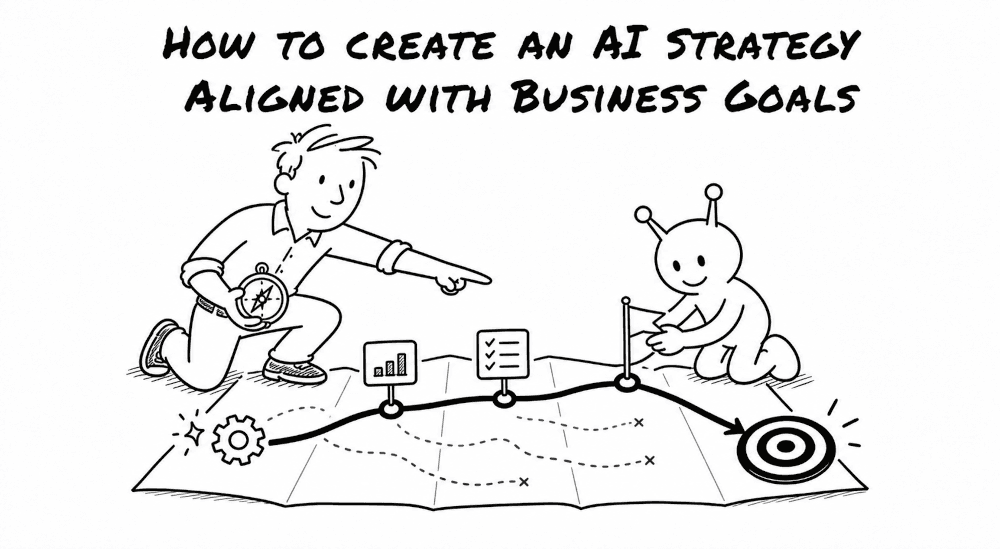
The final strategy should give the company a guiding policy and a 3-to-12-month roadmap.
For each chosen initiative, record:
- The business goal it supports
- The KPI and current baseline
- The target result
- The executive champion
- The initiative lead and team
- The timeframe and review dates
- The data required
- The people, tools, and budget required
- Known constraints and risks
- The first test
- The go/no-go decision rule
- What must be true before the company invests more
Review the roadmap on a fixed schedule. Scale work that produces credible evidence. Change work when the idea is sound but an assumption is wrong. Stop work that cannot show a path to the business goal.
Your first strategy session does not need to solve every AI question. It needs to produce a short list of business problems, one or two projects worth testing, clear owners, and evidence that will guide the next decision.
The goal isn't to be a company that uses AI. The goal is to build a company with AI integrated as a core function across its data, systems, people, and processes.