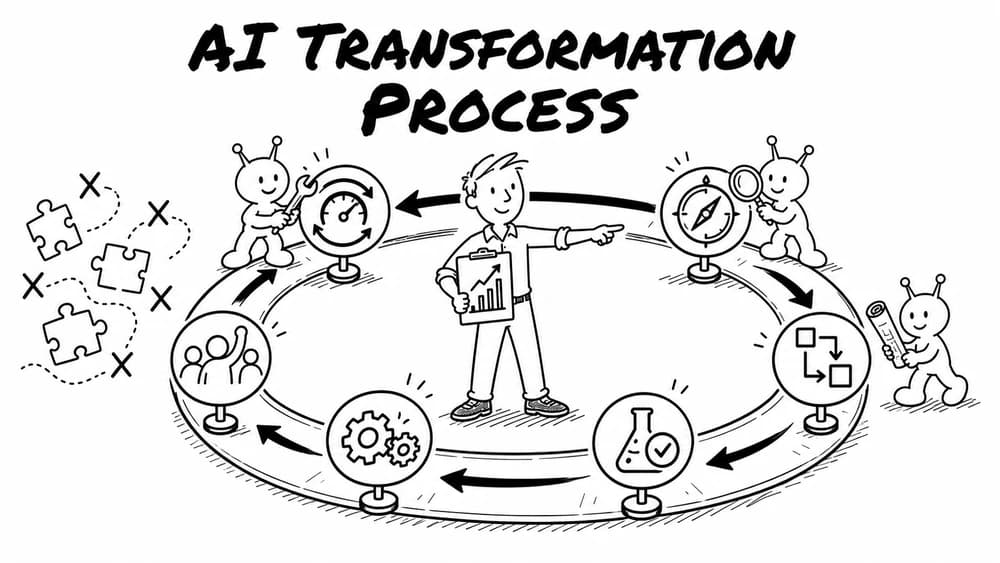
AI Transformation Process
There are millions of small-to-mid sized companies in the U.S. Many are dabbling with AI. Some have a hodgepodge of AI initiatives.
Yet most have no cohesive strategic implementation plan. Even fewer have internal AI talent or the time or resources to stand them up.
They know AI transformation done right helps companies gain an advantage. But what does "done right" mean?
At Superfoo, we set up transformative AI for small to mid sized business that adds real value. We turn your company into an AI-first org (instead of just awkwardly bolting a chatbot on).
Phase 1: AI strategy and planning
AI transformation requires strategy then execution.
This phase is about the what/why/where of AI transformation before we get to the how.
We start with an audit to find the high-impact automation opportunities for AI within your organization. We determine this using frameworks such as RICE (Reach, Impact, Confidence, Effort).
This is also a good time to align on project goals and the KPIs and metrics associated with them.
Goals could include reducing waste, increasing revenue, or improving quality, decision-making, or customer service. Direct business impact is preferable here (expenses decreased, revenue increased). Think what will drive profitability.
Good starting candidates could include renewal management, employee onboarding, or lead follow-up.
Another key piece in this phase is figuring out the internal champions and establishing strong buy-in from leadership. This is crucial for the later change management aspects of the project.
We also realize not every workflow needs advanced AI. Some things should never be automated. We clarify these guidelines upfront.
We end with a preliminary roadmap outlining AI initiatives.
Phase 2: Process and Workflow Mapping
This phase maps out the processes, people, data and systems.
As this is complex, we work with teams to dive deep into the organizational know-how.
After gaining a deep understanding of processes and outputs, we document workflows within your company.
We learn where data is stored, the quality of the data, and any processes or SOPs.
Key questions include: What triggers kick off a workflow? What data needs to be available? Where are humans-in-the-loop needed? What parts, if any, should never be automated?
We look especially for manual, repetitive tasks. It could be someone copying information between software tools, making approvals based set rules, categorizing items, drafting standard messages.
Ideally, we tie hard dollar or time values to the automations.
Phase 3: Initial Pilots
Next, we begin AI pilots to validate feasibility and value before scaling. We usually start with 1 or 2 high-priority workflows that are likely quick wins that add value relevant to our goals.
This could involve prototype agents, custom tools, company knowledge wikis, process improvements, and automated workflows.
We not only build but also test and deploy agents and tools.
All systems and outputs are customized to align with the organization and it's goals.
AI systems are built around the current team processes if possible. However, successful AI transformation often requires redesigns of workflows.
Phase 4: Build Out & Scale
Next is scaling AI organization-wide by operationalizing winning pilots. Use learnings and experience to build out more impactful systems.
This is about making your company data, processes, and systems understandable, or legible, to AI agents.
- Setting up persistent data pipelines to APIs/MCPs to reduce manual data copy-and-pasting;
- Creating custom skills based on company SOPs;
- Setting up file systems that legible to AIs
- Connecting systems such as GitHub repos;
- Setting up security measures using tools like sandboxes;
- Spinning up Slack bots or other interfaces;
- Scheduling cron jobs;
- Determining human checkpoints;
- Imbuing company artifacts throughout the organization.
- Identifying clear rules, security controls and permissions.
Phase 5: Change Management & Adoption
An AI system is only successful if teams are using it regularly.
Most underestimate how important change management is to implement AI to automate workflows.
It's important to incorporate the executive sponsors and internal champions at this point within various levels of the organization.
To increase the likelihood that the systems are adding value, we train the team on agents and set up feedback mechanisms, both automated and manual. Iterate until it's just right.
Phase 6: Ongoing Optimization & Refinement
Treat AI as a continuous improvement loop, not a one-time project. The goal is not AI sprinkled in but baked in. AI deeply integrated into several key workflows.
Optimization involves:
- Monitoring agents performance;
- Setting up for self-improvement mechanisms
- Making improvements;
- Adding new capabilities;
- Fixing bugs;
- Upgrading tech as it ages;
- Keeping logs and using evaluation agents;
- Track wins and losses;
- Set up rules and boundaries;
Always be adjusting agents, workflows and tools due the fast-improving nature of the industry. Ground the adjustments based on feedback and goals.
Use dashboards to measure impact to goals and KPIs to gauge progress versus benchmarks.
Document every tool with SOPs and playbooks so new users of how to use the new streamlined process.
Constantly improve and refine to keep your AI Operating System in peak form.