Redesigning Jobs and Workflows in the AI Era
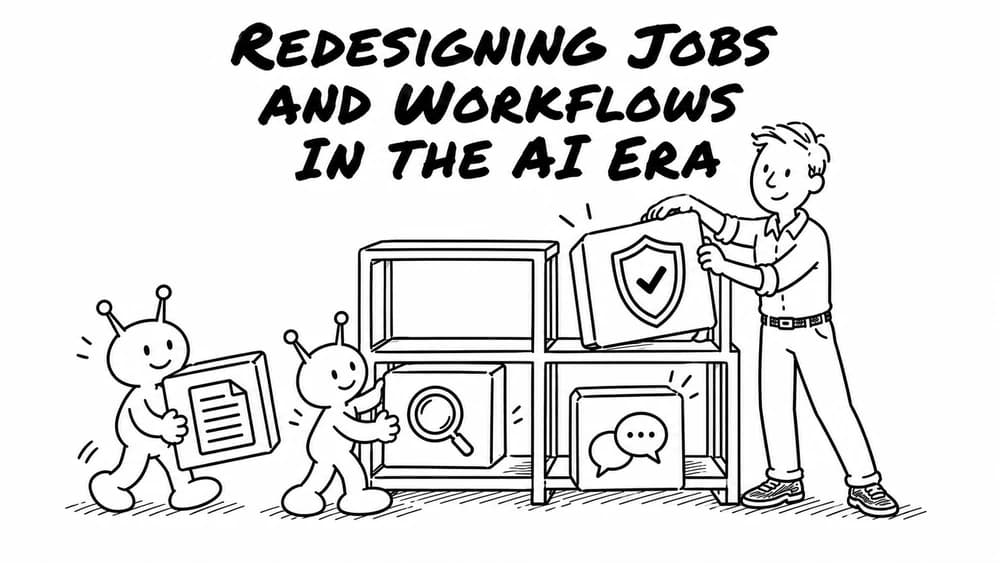
AI is going to reshape most jobs. That part isn't really up for debate anymore.
What's still open is how. Some people think the traditional org chart is on its way out. Others think AI will quietly speed up a few tasks and nothing else changes. Both miss the more useful question for a small or mid-sized business: if AI takes on more of the work inside each job, what should your people become responsible for?
This kind of change is disruptive and easy to get wrong. Redesign carelessly and you can lose the customer knowledge and judgment that made your business good in the first place.
We're not in the business of predicting the future. But here's our take on how AI and the future of work will play out at the job level, plus a practical way to start redesigning roles before the changes happen to you.
Job redesign starts with tasks, not job titles
A job title is a label. The actual job is a bundle of four things: tasks, decisions, relationships, and responsibility.
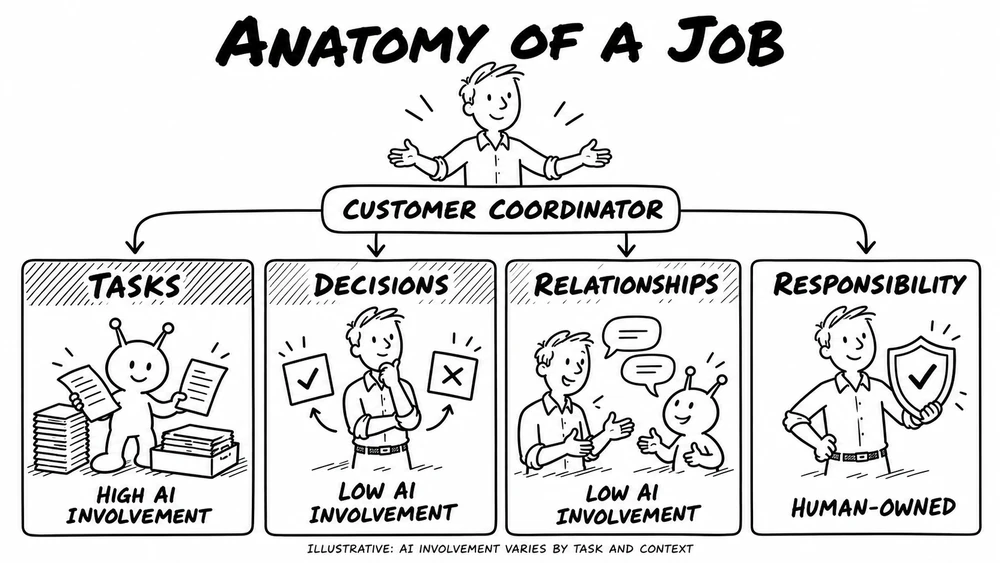
Picture a customer coordinator at a 40-person company. On a normal day, she answers routine questions, digs into unusual cases, pulls in colleagues from billing or operations, and owns the customer relationship when something goes sideways.
Now zoom in on a single customer inquiry. It's really five different kinds of work:
| Step | What happens | Likely AI role |
|---|---|---|
| Sort the request | Figure out what the customer needs and how urgent it is | High: AI can classify and route most requests |
| Find account details | Pull order history, past tickets, contract terms | High: AI can search and summarize |
| Draft a reply | Write a clear, accurate response | Medium: AI drafts, a person checks tone and accuracy |
| Approve an exception | Decide whether to waive a fee or bend a policy | Low: a person decides, maybe with AI-prepared options |
| Follow up | Make sure the issue actually got resolved | Medium: AI can track and remind, a person handles the relationship |
Each step calls for a different level of AI involvement. That's the core of job redesign. The question shifts from "can AI do this job?" to "which parts can AI do, and what happens to the rest?"
AI changes tasks first, but whole roles can still shrink
So far it has been rare for an entire job to get automated in one shot. Usually AI absorbs a growing share of the tasks within a role. It can help with parts of a job long before it can own the whole thing.
But don't take too much comfort in that. Over time, the mix can shift enough that a business needs fewer people in a particular role, or stops hiring for it. Some roles will shrink. A few may disappear. The honest version sits between "AI replaces the job" and "nothing changes."
How to map a job for AI automation and augmentation
Break a role down task by task and a pattern shows up fast:
| Less of | More of |
|---|---|
| Searching for information | Interpreting what the information means |
| Transcription and data entry | Gathering the right data in the first place |
| First drafts of reports and documents | Reading reports and acting on them |
| Status chasing and repetitive handoffs | Handling exceptions and edge cases |
| Routine checks and classification | Understanding customers and making decisions |
| Doing every step yourself | Defining the problem and the desired outcome |
That last row is the big one. The job shifts from doing every step to directing the work and owning the result.
A useful way to picture the new rhythm (some call it the "human sandwich"):
- A person defines the problem and what a good outcome looks like.
- AI gathers context and carries out bounded work.
- A person judges the result, handles the ambiguity, and stays accountable.
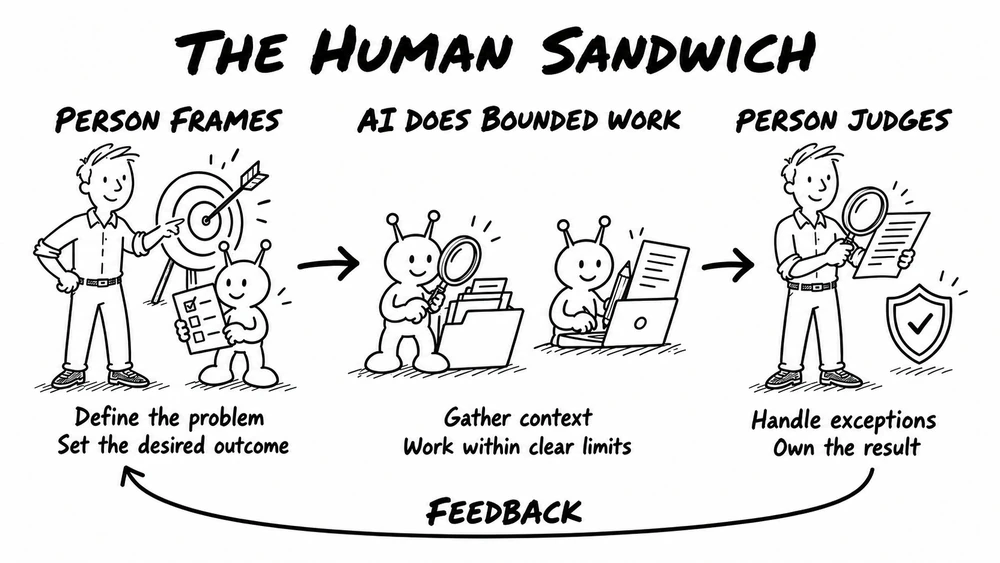
Two caveats. First, not every task needs an AI agent. Predictable, low-variance work is often better handled by regular software. Second, "human in the loop" has to mean real judgment. If your team clicks "approve" without reading, that's not a safeguard.
Here's what this looks like in practice. At Basis, an onboarding agent cut first-day setup for new hires from two hours to 30 minutes. The interesting part is what happened to the HR team's job: they got more room for culture and support, the human parts of onboarding an agent can't do well.
What should your business do with the time AI saves?
This is where most AI conversations stop too early.
Say AI frees up 20% of your team's week. That capacity could become cheaper products, more attentive service, quicker responses to unusual customer needs, a service you couldn't previously afford to offer, more experiments with customers, or fewer hires going forward.
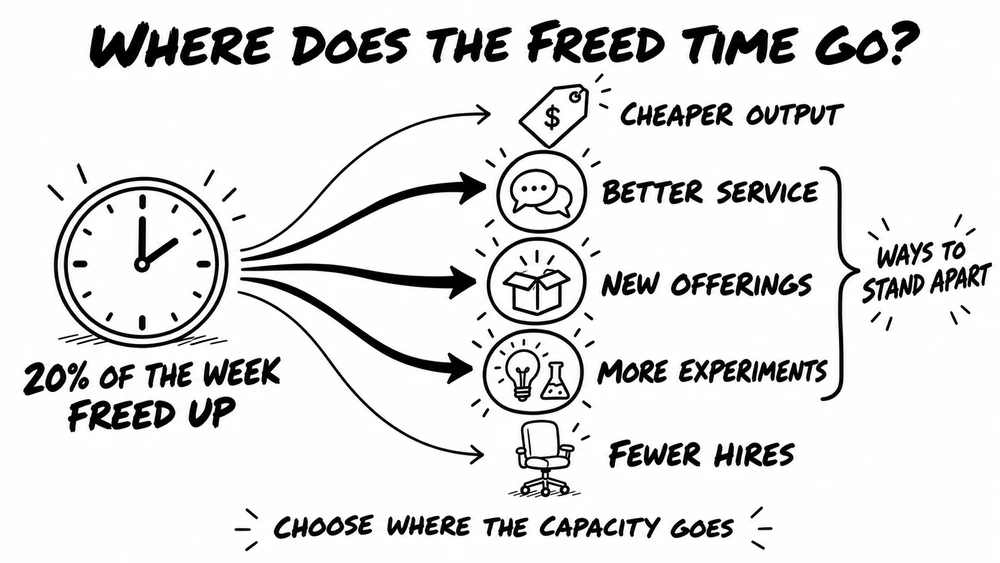
Here's a contrarian take: faster reports and more content are the least interesting options. Competitors get the same productivity gains, so they become table stakes fast. The durable advantage comes from using freed capacity for better work, the kind customers notice.
There's also a paradox. More automation often means more projects in flight, which means more edge cases, customer conversations, and decisions. Even if each person touches less per project, total human work can go up. The team at Every, a media and software company, has described exactly this: aggressive automation led to more expert human work for their team of roughly 30 people. AI might help your team do five times as much. People aren't working five times fewer hours.
The consequences cut both ways
Efficiency could support expansion and new expert roles. It could also reduce headcount. Market demand and owners' choices will decide which, and the net effect on jobs remains to be seen.
Two consequences deserve special attention in a small business. First, displacement may show up as a hire you don't make rather than a layoff, which is easy to miss. Second, when AI absorbs junior tasks, it removes the training ground. The routine work that taught people how your business runs is the same work AI is best at. Protect ways for newer people to watch decisions get made, take on harder cases, and get feedback.
Jobs also get harder. Without the easy routine tasks, what's left is mostly exceptions, judgment calls, and tricky customers. Plan workloads accordingly.
Small teams gain range: broader jobs and new responsibilities
When routine work gets cheap, a capable person can coordinate research, drafting, analysis, and follow-through that used to require several handoffs. Jobs get broader. Hybrid roles are already showing up, like marketers who build their own tools and automations. In an SMB, that range is a real advantage.
Domain knowledge and proximity to the customer matter more
Domain expertise and closeness to the customer start to matter more than a title or a narrow task list. The person closest to a problem may even shape a simple tool for it without becoming a software engineer, like a finance lead who builds her own live dashboard.
New responsibilities inside existing roles
As AI does more, some new work shows up too. In a small business, these usually become parts of existing jobs rather than brand new hires:
- Keeping company knowledge accurate (someone has to own the wiki or "second brain" AI draws from)
- Setting boundaries for what AI can and can't do
- Testing outputs and catching quality drift
- Deciding when a customer or colleague needs a person
That first one is underrated. If no one owns your company knowledge, your AI tools will confidently use outdated policies. That's why we often start clients with an AI knowledge system before more ambitious automation.
What about flatter organizations?
Some companies are betting AI will flatten the org chart. Block has argued that much of traditional hierarchy exists to route information, and has proposed a structure built around individual contributors and player-coaches. Coinbase is reducing reporting layers, removing "pure managers," and experimenting with small AI-native pods (alongside a roughly 14% headcount reduction tied to both market conditions and AI).
These are provocative examples, not templates for a local business. A manager who mostly relays status updates may find less to do. A manager who coaches, resolves trade-offs, and builds judgment in their team may become more valuable than ever.
Redesign roles around outcomes and human accountability
Stop asking "who performs each task?" and start asking "who owns the result?"
Let AI prepare options and handle routine preparation. Give people responsibility for decisions and quality.
As AI takes on more autonomy, responsibility has to stay legible. For any consequential workflow, you should be able to answer:
- Who can authorize a consequential action, like a refund, a contract change, or a customer email?
- Who notices when the AI makes a mistake?
- Who preserves the customer's trust when something goes wrong?
More autonomy makes company knowledge, permissions, and human judgment more valuable, not optional. If you haven't written ground rules for how your team uses AI, start with our guide to creating an AI policy for employees.
AI workflow examples for sales, support, and operations
Here's what job redesign might look like across common SMB roles:
| Role | What AI takes on | What people focus on |
|---|---|---|
| Sales | Account research, meeting prep, follow-up drafts | Discovery, relationships, negotiation |
| Customer support | Suggested answers, history summaries, routing | Unusual, sensitive, or high-value cases |
| Operations | Spotting missing information, drafting schedules and reports | Trade-offs, exceptions, vendor relationships |
| Marketing | Turning one idea into drafts for several channels | Setting the message, approving what goes out |
For concrete starting points, see our post on starter AI agents for business leaders.
How to redesign a job around AI: a 6-step framework
Run this sequence one role at a time:
- Map the role. List its tasks, decisions, relationships, and outcomes. Talk to the person doing the job. The real work rarely matches the job description.
- Decide which tasks are likely to be automated or augmented. Use the "less of / more of" lens. Flag what AI can do now and what it will likely handle within a year or two.
- Consider how the org chart could change. Will roles combine? Does a manager shift from routing information to coaching? Is there a hire you won't need, or a new one you will?
- Assign accountability. For each AI-assisted workflow, decide who reviews, who approves, and who handles exceptions.
- Decide where freed capacity goes. Better service, more projects, new offerings, or reduced workload. Make this a deliberate choice, not an accident.
- Test and update the role. Measure quality and workload, not just time saved. Revisit the role as the tools improve.
One rule of thumb: don't pile AI duties on top of an existing workload. If someone now supervises agents and maintains knowledge, something else should come off their plate.
For how this fits into company-level change, see our breakdown of the AI transformation process.
Are we all going to be agent managers?
Maybe. Some of us, at least partly.
Anyone who claims to know exactly how jobs will look in five years is guessing. What's clear is that the mix of work inside most roles is already shifting.
SMBs have an advantage here. You can change workflows without a massive reorganization or a two-year rollout plan. Redesign one role, see what works, and adjust next quarter.
The businesses that win won't just ask which jobs AI can do. They'll ask what their people should become responsible for, and what the business can now become better at. That answer will shape both the employee experience and the customer experience.
Want help mapping roles and deciding where AI fits? Our AI strategy and consulting team works with SMBs on exactly this, and we build the AI agents and automations to power the redesigned workflows. Book a consultation to get started.