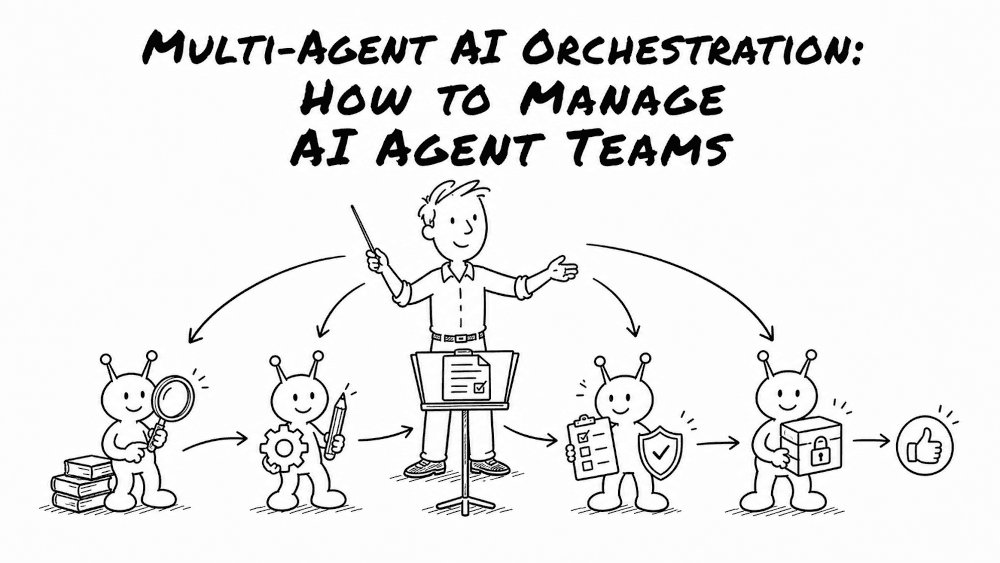
Multi-Agent AI Orchestration: How to Manage AI Agent Teams
Getting one AI agent to work feels like a breakthrough.
Getting five agents to work together feels like management.
That’s multi-agent orchestration.For a small or mid-sized business, the answer usually isn’t an enterprise control center with 40 dashboards. But it also can’t be five agents chatting in a shared thread and hoping the work comes together. You need an operating system around them.
Here’s how to build it.
What is AI agent orchestration?
AI agent orchestration is the process of assigning work across agents, managing how they communicate, preserving workflow state, enforcing limits, and verifying that the whole system produced the intended business result.
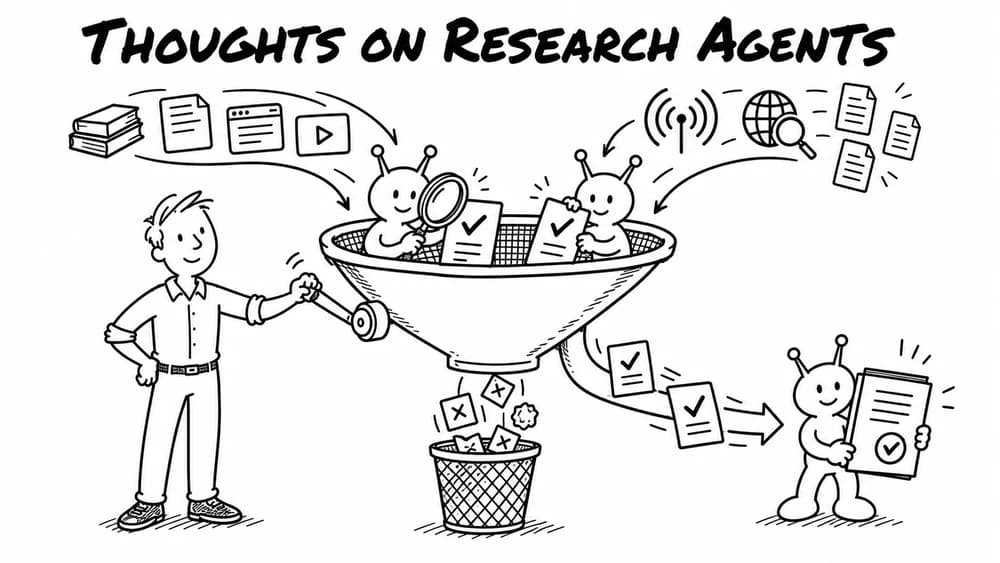
Think of an individual agent as a capable temp worker. It can reason, use tools, and produce work, but its context window is temporary. It may lose information, hit a limit, fail midway, or return an answer that sounds finished when the actual task is still incomplete.
The orchestration layer provides the structure around that worker. It handles things like:
- Which agent receives a task
- What tools, data, and permissions it can use
- What information must travel to the next agent
- Where plans, decisions, and outputs are stored
- How retries, failures, and conflicting recommendations are handled
- When another agent or human must review the work
- How cost, quality, speed, and completion are measured
This distinction matters. A collection of agents is not automatically a multi-agent system. The agents need distinct responsibilities and a controlled way to complete shared work.
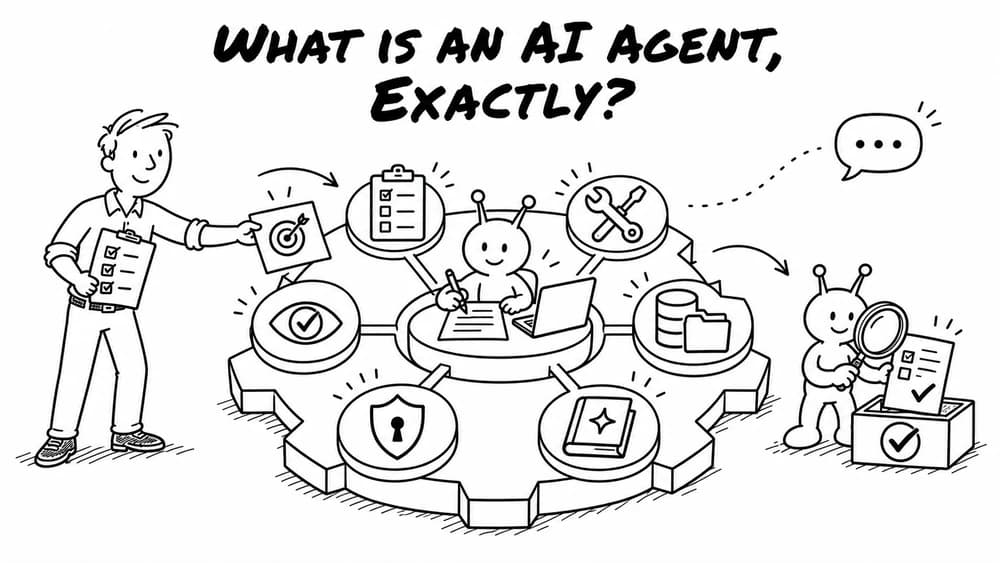
If you’re still defining what an agent can do on its own, start with What Is an AI Agent, Exactly?. Multi-agent management starts after those individual pieces are useful.
Single-agent vs. multi-agent AI systems
More agents can increase throughput and reliability. They can also create more places for work to stall.
Every new agent adds another possible handoff, dependency, permission boundary, cost center, and failure point. In practice, workflow complexity is driven less by the number of agents than by the number of connections between them.
Start with one reliable agent. Add a specialist only when the separation creates a clear operational benefit.
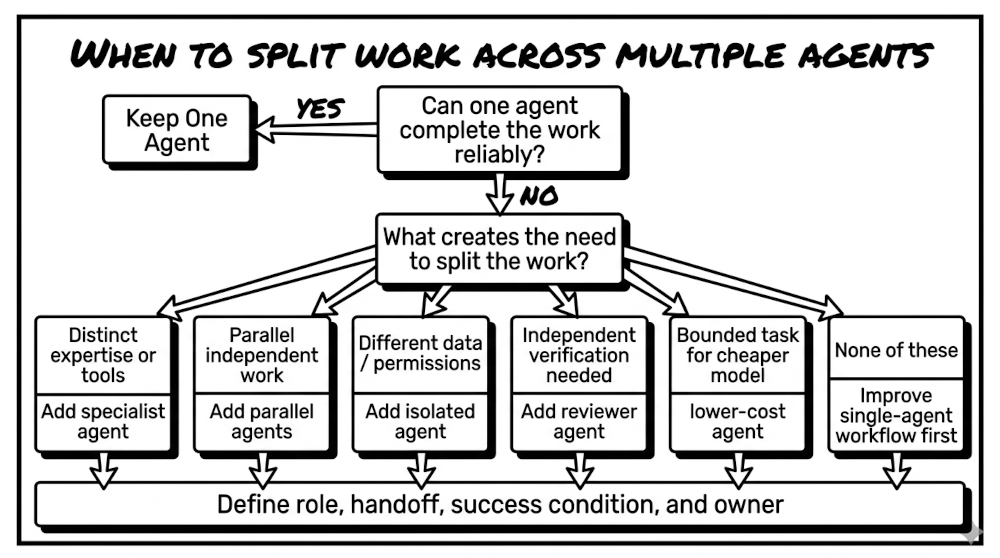
A research agent, writer, and compliance reviewer may make sense because each has a different job. Splitting one prompt among three nearly identical “personas” usually doesn't lead to useful specialization.
And if a process is fully predictable, regular code will do. Scheduling, schema validation, file movement, budget enforcement, and state changes are better handled by deterministic code. Let models handle judgment. Let software handle control.
How AI agents should communicate
Agent-to-agent communication should look more like a structured handoff than an unmoderated group chat.
Messages are fine for notifications and routing. They’re a weak place to store the only copy of a plan, decision, approval, or final artifact. An agent can crash, restart, exhaust its context, or get replaced by a different model. If the work exists only in message history, the next agent may have to reconstruct it from scratch.
A better pattern is message plus artifact reference.
The message says what happened and who should act next. A durable file, database record, task object, or other shared workspace holds the actual work.
Each important handoff should include:
- The task and success criteria
- The inputs and sources used
- The artifact or result produced
- Key decisions and assumptions
- Current status, such as
completed,blocked, orneeds review - Errors, retries, and unresolved questions
- Evidence that supports the completion claim
- The next agent or human expected to act
Version those artifacts when several agents may touch them. Passing a known version forward creates lineage: you can see what each agent received, what it changed, and where a bad result entered the workflow.
A shared workspace doesn’t mean unlimited shared access. Separate folders, branches, sandboxes, or permission-scoped stores can prevent agents from overwriting one another’s work. Claims, queues, locks, or simple ownership rules can stop two agents from acting on the same customer record or document at once.
For many SMBs, this shared state can start as a well-designed folder structure, project database, or workflow table. You need a source of truth that survives the conversation. It doesn't need to be complex.
Where the A2A protocol fits
As agent portfolios spread across vendors and frameworks, common communication standards become useful. Agent2Agent (A2A) is an open protocol designed to let agents built with different frameworks and running on separate servers work together without exposing their internal memory, tools, or proprietary logic. Agents publish “Agent Cards” that describe their capabilities and connection details, then exchange text, files, and structured data through a standardized interface. The protocol also supports immediate responses, streaming, and longer-running tasks.
For an SMB, A2A could make specialist agents easier to discover, connect, and replace as the system grows. But a communication protocol is only one part of orchestration. You still need to decide which agent should act, what it can access, where workflow state lives, how much it can spend, what counts as complete, and when a human must step in.
Choose the simplest orchestration pattern that fits
Most SMB use cases fit one or more of five patterns:
| Pattern | Best fit | Main risk |
|---|---|---|
| Sequential pipeline | Work with clear dependencies, such as research, draft, review, approval | One weak output contaminates every later step |
| Parallel delegation | Independent research, analysis, or document sections | Results overlap, conflict, or fail to integrate |
| Supervisor | Ambiguous goals that require planning, routing, and synthesis | The supervisor becomes a costly bottleneck |
| Independent reviewer | Customer-facing, regulated, financial, or otherwise consequential work | Review loops run too long or optimize the wrong thing |
| Event-driven | Monitoring, recurring operations, and responses to system events | Duplicate actions, silent failures, or runaway retries |
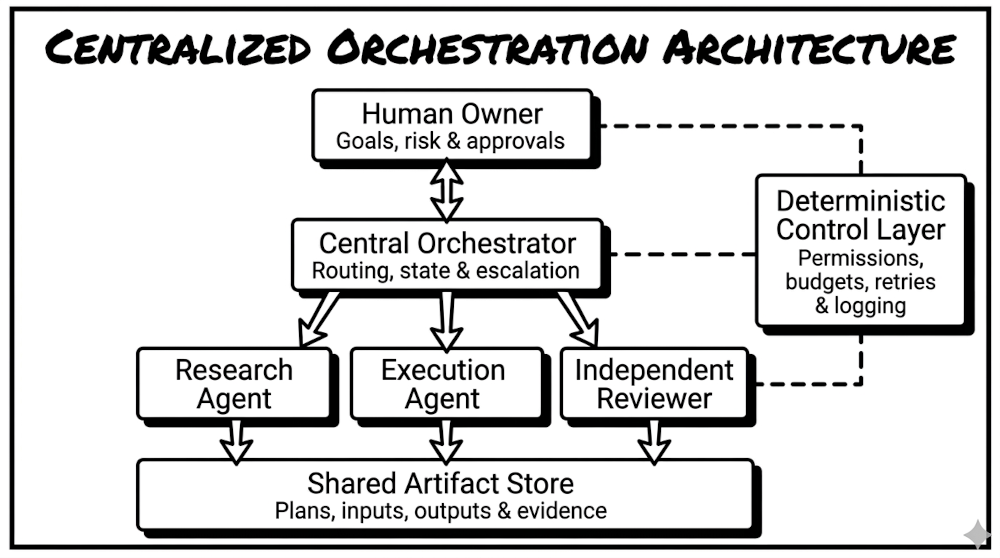
Centralized orchestration is usually the easiest starting point for an SMB. One coordinator assigns tasks, tracks state, handles retries, and accepts final outputs. It’s easier to debug because one component can see the whole workflow.
More independent, event-driven agents can work well later. They also need stronger controls for idempotency, ownership, budgets, and tracing. Start centralized, then loosen the structure when a real use case demands it.
Manage agents as a versioned portfolio
Once agents run across different tools, vendors, or computers, create a basic agent registry. A spreadsheet or database is enough to begin.
Record each agent’s:
- Purpose and business owner
- Capabilities and known limits
- Model, instructions, tools, and version
- Data access and permissions
- Runtime location and current status
- Cost and performance history
- Workflows that depend on it
Models, prompts, APIs, and connectors change. An agent that performed well last month can quietly produce different results after an update. Version important configurations, test changes before broad rollout, and keep a rollback path.
You also don’t need one model for every role. Use smarter models for planning, conflict resolution, synthesis, and high-impact judgment. Use cheaper/faster or specialized models for bounded work such as extraction, classification, formatting, and routine monitoring. Measure cost per successful outcome, not cost per token. A cheap model that fails three times isn’t cheap.
Verification, observability, and human control
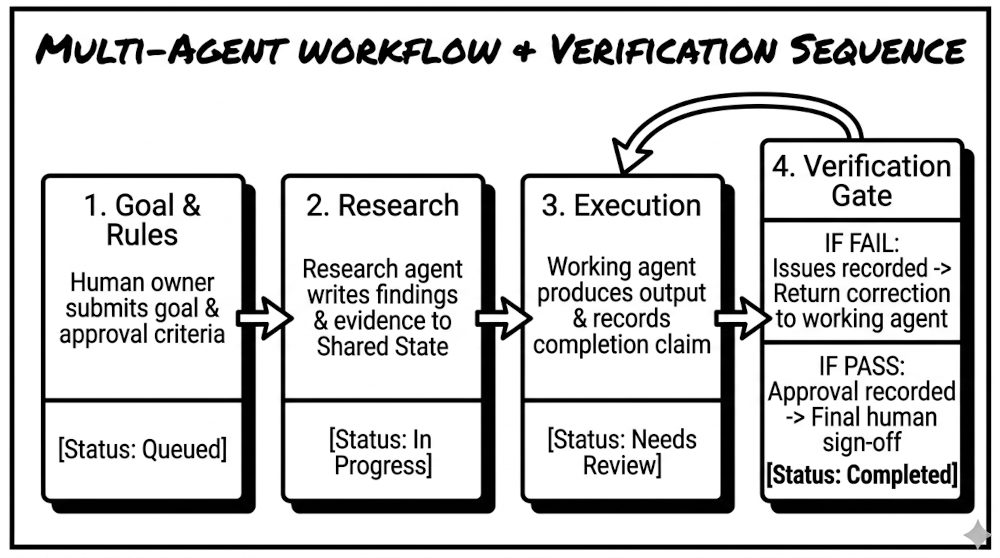
Treat “done” as a claim, not a fact.
An agent saying it completed a task is agent testimony. A tool reporting that it ran provides execution evidence. Tests, records, or human review confirming the intended outcome provide actual verification.
Important handoffs should have a gate. Depending on the task, that might mean:
- Confirming the expected file exists and contains real content
- Running a schema, calculation, test, or policy check
- Comparing the output with the original goal
- Requiring a different agent to review the result
- Asking a human to approve a customer message, payment, or destructive action
The producing agent shouldn’t be the only judge of its own work. A separate reviewer has a different objective and a clean context. For low-risk tasks, deterministic checks are even better.
Observability makes failures diagnosable. Track the entire workflow and each component inside it:
- End-to-end completion rate
- Completion rate by agent and stage
- Human correction and override rate
- Retries, escalations, and recurring failure categories
- Time and cost per successful outcome
- Tool calls and permission violations
- Recovery after an interruption
Save successful and failed traces. When a human fixes something, update the relevant instruction, shared skill, test, or routing rule. Otherwise, your team will keep correcting the same mistake forever.
This builds on the testing and governance approach in Your First AI Pilot, but applies it at both the agent and workflow level.
Put hard boundaries around autonomy
Agents are probabilistic. The controls around them don’t have to be.
Every multi-agent workflow should define:
- Maximum runtime, retries, tokens, and spending
- Allowed tools, data, and network access
- Isolated execution where mistakes could cause damage
- Conditions that produce
blockedinstead of more improvisation - Human approval points based on risk
- A real-time way to stop execution
- Rollback or compensation steps for partial actions
Autonomy should be earned through observed reliability. Read-only research may run unattended. Internal drafts may need review. External messages, financial activity, sensitive-data transfers, and destructive changes deserve stricter approval.
This is where AI readiness becomes operational. Data quality, security, ownership, evaluation, and budget controls can’t stay in a strategy document. They have to show up in the workflow itself.
A practical SMB rollout plan
You can build useful multi-agent workflows without recreating an enterprise platform. Start with one high-value process and add management structure as the workflow proves itself.
- Define the business outcome. Pick an observable win condition, not “the agents communicated successfully.”
- Map the real workflow. Include review, exceptions, approvals, and downstream work.
- Start with one agent. Add specialists only where isolation, permissions, parallel work, or independent review creates value.
- Choose a simple pattern. A sequential pipeline with a coordinator and reviewer is enough for many SMB projects.
- Create handoff contracts. Define required inputs, artifacts, statuses, evidence, and next actions.
- Add deterministic controls. Enforce budgets, retries, permissions, state transitions, and verification outside the model.
- Measure and improve. Review failures, update shared procedures, test changes, and expand autonomy carefully.
A practical content workflow, for example, could use a research agent, a drafting agent, and an independent fact and brand reviewer. The orchestrator owns the brief, routes the artifacts, checks required fields, records cost, and holds the draft for human approval. That’s already a real multi-agent system. No AI executive org chart required.
Build the smallest agent team that can reliably finish the job. Then make it earn the right to grow.
If you’re ready to turn a proven workflow into a managed agent team, Superfoo’s AI Agents & Automations and AI Knowledge Systems services can help you design the agents, shared state, controls, and evaluation layer around it.