Vibe Coding vs. Agentic Engineering
Someone recently asked me if I "vibe code." While potentially pretentious, I think the terms agentic coding or agentic engineering are more apt.
So what is the difference between vibe coding and agentic coding?
Both vibe coding and agentic coding leverage AI to generate functional code.
The difference comes down to production-quality work. Later on we will cover the core concepts for this effort.
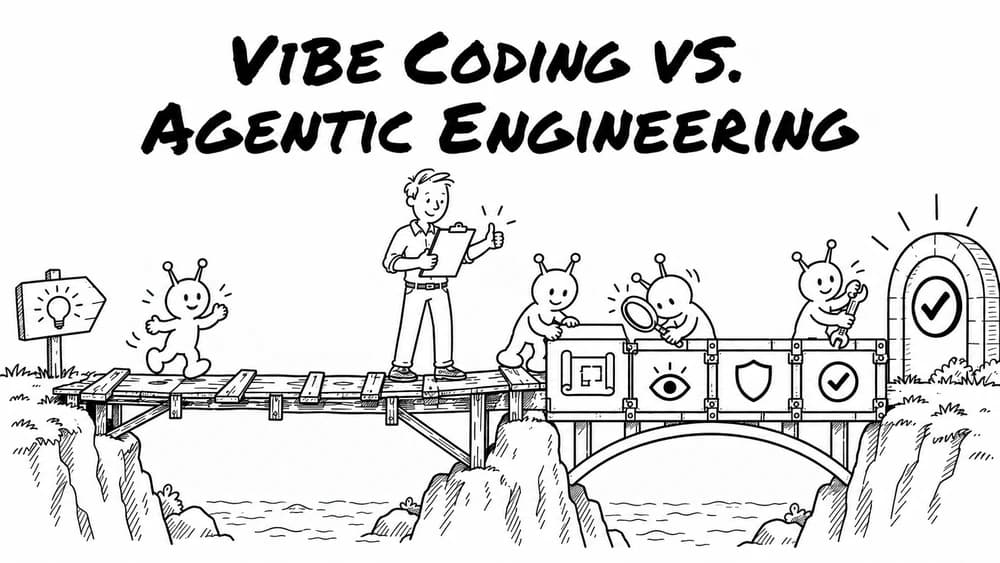
Vibe coding is getting to 80% the way there while agentic coding is the crucial, and often hardest, last mile required to get the project across the finish line. Vibe coding leads to "mostly works" while agentic engineering is more robust addressing advanced issues like edge cases.
It should be noted that vibe coding is not inherently bad. In fact, it can be the best approach for some tasks. For example, a local micro software tool that automates a tedious task but is not super polished or externally facing. Good enough. Agentic engineering is needed when compliance is crucial and mission-critical projects where failure is costly.
Encouragingly, agent harnesses like Codex, Claude Code, and Hermes are incorporating more professional elements into the code generated to level it up from vibe coding quality to agentic engineering quality. I am seeing a lot more testing, such as unit tests and dry runs, to promote stability as opposed to just generating code that it believes will probably work.
Here are four key concepts for graduating from vibe coding to agentic engineering.
Observability
Observability is extremely important given how much development is handed off to agents to generate code. Traces, error messages, and logs provide visibility and transparency that most vibe coders don't consider. This data can be fed back into a self-improving system with agentic loops.
Security and Isolation
This is about not allowing code to execute in certain environments. Use Git worktrees, Docker containers, and dedicated sandboxes to contain untrusted execution. Never hardcode API keys directly in code. Use proxies. Maintain a strict security checklist for input sanitization, authorization, secure data handling. No system is 100% secure but this will reduce the blast radius.
Quality Assurance
Agents will often say their own work is great even if it isn't. Agentic engineering uses multiple agents to review code, scan for vulnerabilities, check performance benchmarks, and ensure it aligns with organizational standards.
Evals and Testing
Code should be tested in a granular manner through methods like unit testing. Test valid and invalid inputs as well as edge cases. Verify the agent's output (like website screenshots) versus the standard using the LLM as the judge.
What about Agentic loops?
Loops are a hot topic now since Peter Steinberger, who created OpenClaw, tweeted about it. I think this could be part of a definition of agentic coding but it's not core to the way I am using the term agentic coding which is more about using agents to create code versus having autonomous agents within or in charge of the code. Agent loops, for the record, are when a continuous recursive loop is present in the code such that agents are prioritized over humans in the loop. The human defines the loop, but then lets the agent iterate until a verifiable goal is achieved or maximum turns are reached. The human's job levels up from prompting agents to do something to creating a loop that prompts agents to do something.
If you have ever tried to replicate a SaaS tool you probably experienced the difference between a vibe coded tool and a production-ready software tool. Thousands of little improvements and enhancements were incorporated into the SaaS tool over several years, if not decades. That matters. Agentic engineering will make achieving this level of quality easier, yet the reps put in for fixings items like edge cases still matter. Some edge cases, gotchas, and other idiosyncrasies will never be fully known to the agent. These are things that could create issues for both vibe coded and agentic coded development just the same.
Agentic engineering is creating a new paradigm: better, smarter, and faster. Better context engineering incorporates complex information such as system architecture, conventions, workflows, and plans into all work. Smarter agents map systems in a clearer manner than was ever possible so engineers can more easily comprehend. Faster testing, issue fixes, and documentation updates that are automatically executed with each change.